I.Definition of Specialty Engineering Plastics
Specialty engineering plastics, as an important branch of the plastics industry, are a class of engineering plastic materials with high overall performance and a long-term service temperature of 150°C or higher. Examples include polyphenylene sulfide (PPS), polyimide (PI), polyetheretherketone (PEEK), liquid crystal polymers (LCP), and polysulfone (PSU). These plastics feature a rigid backbone, high melting points, and orderly molecular chain arrangements, exhibiting excellent stability in high-temperature environments. Specialty engineering plastics can meet specific performance requirements such as high-temperature resistance, corrosion resistance, and wear resistance, and are used in the manufacture of electronic components, insulating materials, chemical processing equipment, and automotive engine parts. As new downstream applications continue to be discovered, specialty engineering plastics are becoming a focal point of attention across various industries.
II.Classification of Specialty Engineering Plastics
The main classification criteria for the specialty engineering plastics industry include material type, performance characteristics, and application areas:
1. Polyphenylene sulfide (PPS): Possesses excellent heat resistance, chemical resistance, and electrical insulation properties, and is widely used in automotive components, electronics, electrical appliances, and chemical processing equipment.
2. Polyimide (PI): With outstanding high-temperature stability, chemical resistance, and mechanical strength, it is widely used in high-temperature components for the aerospace, electronics, and automotive industries.
3. Polyetheretherketone (PEEK): With excellent high-temperature stability, chemical resistance, and mechanical properties, it is widely used in the aerospace, medical device, and petrochemical sectors.
4. Liquid Crystal Polymer (LCP): With excellent dimensional stability, low friction, and high-frequency characteristics, it is commonly used in the manufacture of electronic packaging materials and micro-components.
5. Polysulfone (PSU): With excellent temperature resistance, corrosion resistance, and electrical insulation properties, it is widely used in chemical equipment, electronic components, and medical devices.
III.Background of the Research and Development of Specialty Engineering Plastics
The development of specialty engineering plastics was primarily driven by the demand for high-performance materials, spurred by the international arms race at the time, particularly the need for applications in high-tech fields. At that time, major companies in Europe and the United States invested substantial financial and human resources in a race to develop these materials. From the early 1960s through the 1980s, these materials were largely standardized. The following are several types of specialty engineering plastics:
01
Polyimide (PI)
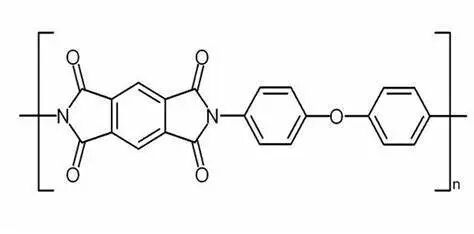
Polyimide (PI) was first developed and commercialized by DuPont in the United States under the brand name Kapton. It is an amorphous polymer with a glass transition temperature (Tg) above 400°C. PI is an aromatic heterocyclic polymer containing imide rings (-CO-NH-CO-) in its main chain. It possesses excellent properties such as electrical insulation, mechanical strength, chemical stability, resistance to aging, radiation resistance, and low dielectric loss; moreover, these properties remain largely unchanged over a temperature range of -269 to 400°C. It is currently the most heat-resistant polymer material in industrial production and is therefore listed as “one of the most promising engineering plastics of the 21st century.” The structural formula of the PI repeating unit is:
02
Polyamideimide (PAI)
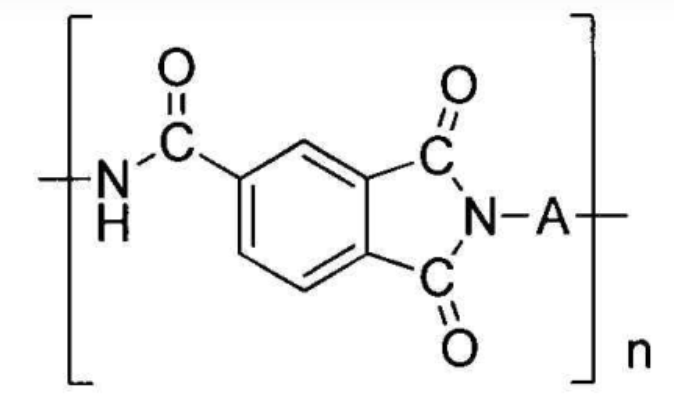
Polyamideimide (PAI), first developed by Toray Industries, Inc. of Japan under the brand name Torlon, is an amorphous, non-thermoplastic polymer with a glass transition temperature (Tg) of 285°C. PAI is a class of polymers in which imide rings and amide bonds are arranged in a regular alternating pattern. Its strength is unmatched by any unreinforced industrial plastic in the world today; it exhibits superior mechanical properties at 250°C, with a heat deflection temperature of 269°C. PAI’s wear resistance, chemical resistance, and resistance to high-energy radiation make its performance even more outstanding, making it highly suitable for use in harsh operating environments. The structural formula of the PAI repeating unit is:
03
Polyetherimide (PEI)
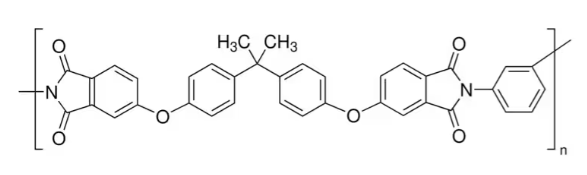
Polyetherimide (PEI) was first researched and developed by GE in the United States in the 1970s. After 10 years of pilot production and testing, it was commercialized in the 1980s under the brand name ULTEM. It is an amorphous polymer with a Tg of 217°C. Unlike the first two materials, it is a thermoplastic polyimide that can be processed using thermoplastic techniques such as extrusion molding and injection molding. PEI is typically transparent with an amber hue. It exhibits excellent high-temperature stability, mechanical properties, chemical stability, and electrical properties. Its key characteristics include a high strength-to-weight ratio, strength retention up to 200°C (390°F), long-term resistance to thermal oxidation, good electrical properties, and inherent chemical resistance and flame retardancy. PEI retains its properties even after prolonged exposure to steam and hot water, which is a major advantage for food processing equipment and medical applications requiring vigorous cleaning or sterilization. The structural formula of the repeating unit in PEI is:
04
Polysulfone (PSU)
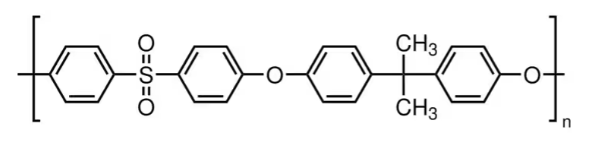
Polysulfone (PSU) was successfully developed and commercialized by United Carbides Corporation (UCC) in the late 1960s under the brand name UDEL. It is an amorphous polymer with a glass transition temperature (Tg) of 192°C. In 1986, UCC transferred the production and sales rights for polysulfone to Amoco. The main chain of PSU contains benzene rings, and the sulfur atom in the -SO₂- group is in its highest oxidation state; consequently, it exhibits good oxidation resistance, mechanical properties, and thermal stability, while the presence of ether bonds provides a certain degree of toughness. PSU has excellent electrical insulation properties and is widely used in the electrical industry. In the medical field, PSU is commonly used to manufacture medical devices, such as hemodialyzers, due to its good biocompatibility and resistance to sterilization. In the food processing sector, PSU can be used to manufacture certain high-temperature-resistant equipment. Additionally, PSU has some applications in the aerospace and electronics industries. Currently, there are three commercially available and relatively mature types of polysulfone resins: bisphenol A-type polysulfone (PSU), polyphenylsulfone (PPSU), and polyethersulfone (PES). The structural formula of the repeating unit of PSU is:
05
Polyethersulfone (PES)
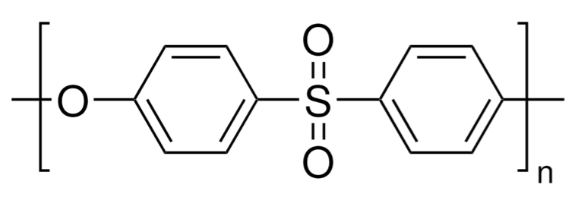
Polyethersulfone (PES) was successfully developed and commercialized by the British company ICI in the 1970s. Sold under the trade name PES, it is an amorphous polymer with a glass transition temperature (Tg) of 225°C. The molecular structure of PES contains neither aliphatic hydrocarbon units—which have poor thermal stability—nor rigid biphenyl units; it consists primarily of sulfone groups, ether groups, and phenyl groups. The sulfone groups confer heat resistance, while the ether groups give the polymer chains good fluidity in the molten state, facilitating molding and processing. PES possesses excellent heat resistance, physical and mechanical properties, and electrical insulation properties. It can be used continuously at high temperatures and maintains stable performance in environments subject to rapid temperature changes. It is resistant to corrosion by most chemical media; polyethersulfone does not undergo hydrolysis in water, but trace moisture absorption can cause slight plasticization, resulting in minor changes in mechanical properties. Furthermore, polyethersulfone is self-extinguishing and exhibits excellent flame resistance without the addition of any flame retardants. PES is widely used in the electronics, electrical, mechanical, automotive, medical device, and hot water sectors. It is recognized as an engineering plastic that combines a high heat deflection temperature, high impact strength, and excellent processability. The structural formula of the repeating unit of PES is:
06
Polyarylate (PAR)
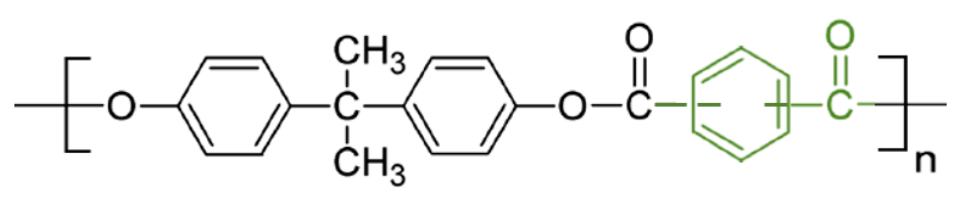
Polyarylate (PAR) is a general term for a family of aromatic polyester products. The first such product to be successfully developed and commercialized was created by the Japanese company UNITIKA in the early 1970s under the trade name U-polymer. It is an amorphous polymer; specifically, U-100 has a Tg of 193°C. PAR is a specialty engineering plastic with benzene rings and ester groups on its main chain. The high density of aromatic rings in the main chain enhances its heat resistance, with a heat deflection temperature of 175°C. The presence of para- and meta-benzene ring units in the main chain inhibits polymer crystallization, resulting in an amorphous, transparent polymer. Its transparency is on par with that of PC and PMMA, with a light transmittance of nearly 90%; it exhibits good flexural resilience and excellent creep resistance over a wide temperature range; it has outstanding weather resistance, blocks UV radiation below 350 nm, and maintains essentially unchanged mechanical properties under long-term outdoor conditions; it is self-extinguishing, produces minimal smoke when burning, and is non-toxic. PAR is a polymeric material with excellent heat resistance; its structural formula and synthesis methods vary depending on application requirements. It can be used in high-temperature-resistant electronic devices, as well as components and parts for the aerospace and automotive industries, and is also commonly used in medical devices. Its applications across multiple industrial sectors demonstrate its significant value as a specialty engineering plastic. The structural formula of the repeating unit of PAR is:
07
Polyphenylene Sulfide (PPS)
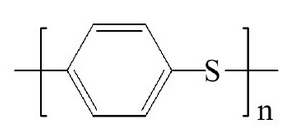
Polyphenylene sulfide (PPS) was first developed and commercialized in the 1970s by Philips in the United States under the brand name Ryton. It is a crystalline polymer with a glass transition temperature (Tg) of 88°C and a melting point (Tm) of 277°C. PPS consists of an alternating arrangement of benzene rings and sulfur atoms, giving it a regular structure and high crystallinity—as high as 75%—with a melting point of up to 285°C. The benzene rings provide PPS with good rigidity and heat resistance, while the sulfide bonds impart a certain degree of flexibility. PPS exhibits excellent heat resistance, flame retardancy, electrical insulation, and corrosion resistance. Its comprehensive properties—including thermal stability, mechanical strength, and electrical performance—enable it to withstand long-term exposure to temperatures as high as 220°C. As a result, PPS is hailed as the “world’s sixth-largest engineering plastic,” following polycarbonate (PC), polyester (PET), polyoxymethylene (POM), nylon (PA), and polyphenylene oxide (PPO). The structural formula of the repeating unit in PPS is:
08
Polyetheretherketone (PEEK)
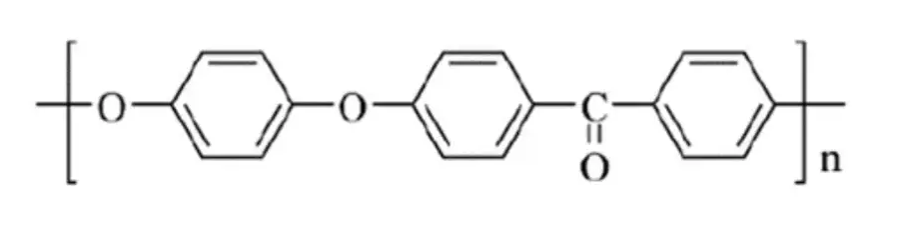
Polyetheretherketone (PEEK) was first successfully developed and commercialized in the 1970s by the British company ICI. ICI successfully synthesized PEEK and began marketing it in 1978; it has been sold under the Victrex brand ever since. The commercial name is PEEK. It is a crystalline polymer with a glass transition temperature (Tg) of 143°C and Tm = 334°C. PEEK is a crystalline, ultra-high-temperature thermoplastic polymer composed of repeating units containing one ketone bond and two ether bonds in its main chain structure. The molecular structure of polyetheretherketone contains rigid benzene rings, giving it excellent high-temperature performance, mechanical properties, electrical insulation, flame retardancy, radiation resistance, and chemical resistance. PEEK has a melting point (Tm) as high as 340°C; this high melting point gives PEEK outstanding high-temperature resistance. The heat deflection temperature of fiber-reinforced PEEK can reach up to 315°C, while its long-term continuous service temperature (UL946B) can reach 260°C, and its short-term heat resistance extends up to 300°C. Even after 5,000 hours of use at 260°C, its strength remains virtually unchanged from its initial state, and it exhibits excellent thermal stability. Consequently, PEEK has a long service life in harsh environments. The structural formula of the repeating unit in PEEK is: