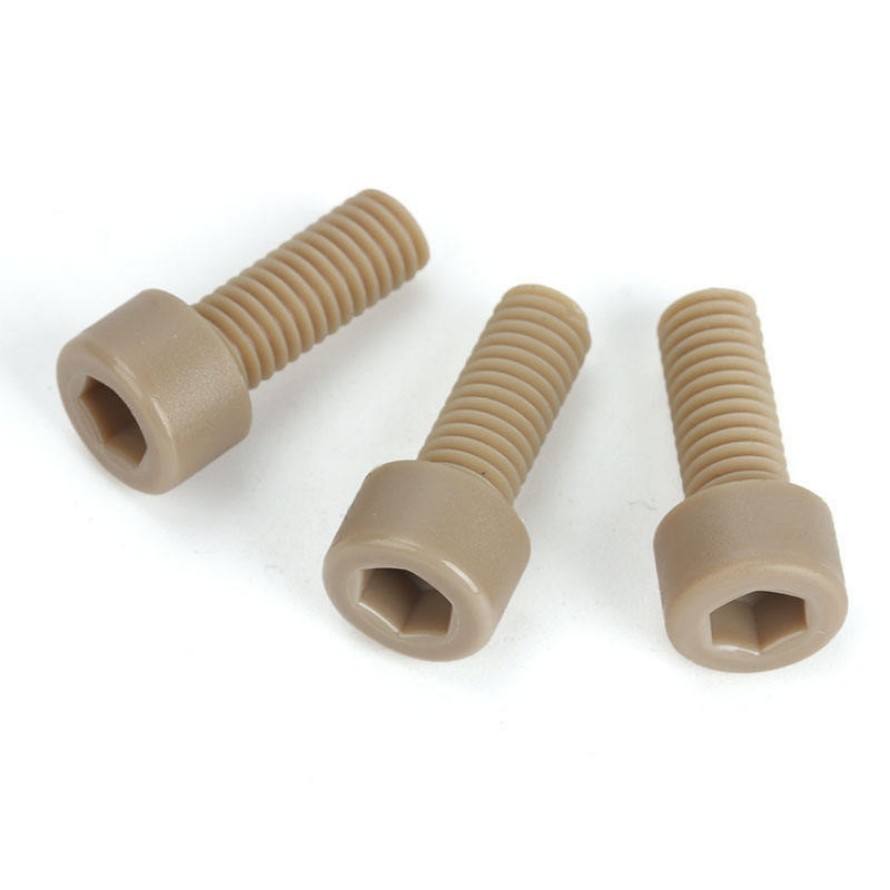
Say goodbye to rust problems, corrosion-resistant PEEK screws are suitable for extreme environments in multiple industries.
In extreme environments such as chemical and semiconductor industries, PEEK screws easily withstand the challenges of acids, alkalis, salt spray, and high temperatures with their exceptional corrosion resistance and high-temperature resistance. They require no anti-corrosion treatment, have a lifespan far exceeding that of metal screws, and also offer the advantages of being lightweight, insulating, and non-magnetic, making them an ideal fastening choice for high-end manufacturing.
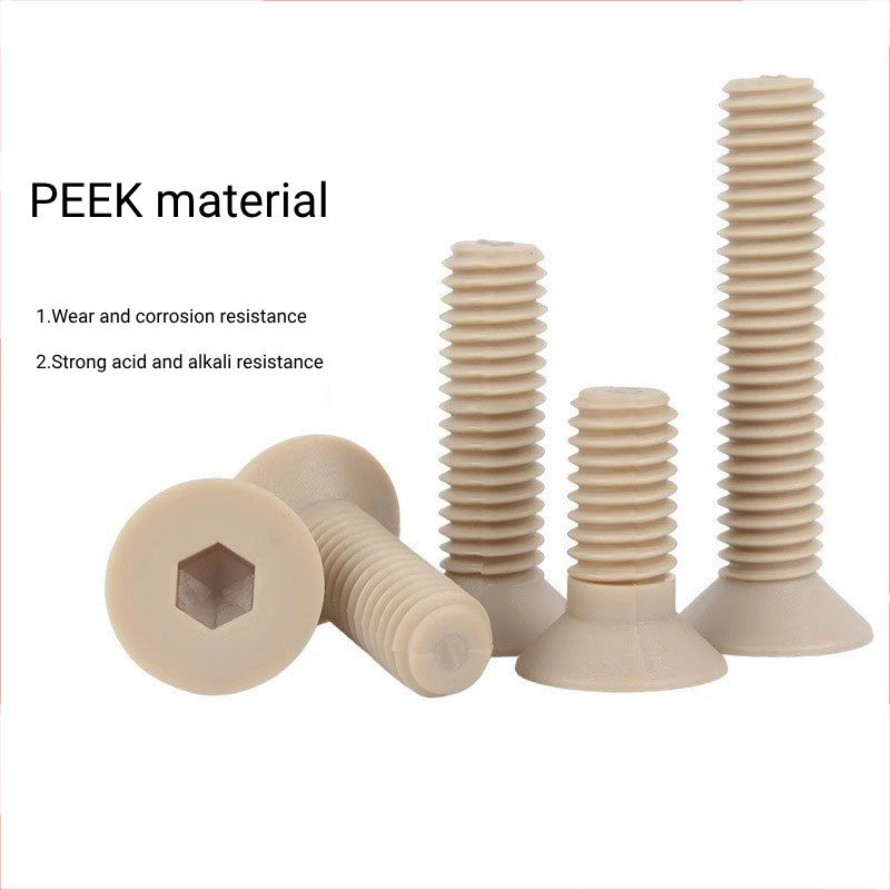
In many harsh industrial manufacturing scenarios, screws, as fundamental fastening components, directly determine the stability and lifespan of equipment. While traditional metal screws possess a certain mechanical strength, they are prone to corrosion, breakage, and failure in corrosive environments such as acids, alkalis, salt spray, and high temperatures. This not only increases equipment maintenance costs but can also pose safety hazards. Corrosion-resistant PEEK screws, with polyetheretherketone (PEEK) as their core material, have become an ideal choice for solving fastening challenges in harsh environments due to the material's superior properties. They are widely used in high-end fields such as chemical, semiconductor, medical, and aerospace industries, redefining the standard for high-performance fasteners.
PEEK material, as a "performance benchmark" among special engineering plastics, possesses exceptional corrosion resistance due to the stable benzene rings and ether bonds in its molecular structure, which is its core competitive advantage. Unlike traditional stainless steel and titanium alloy screws, PEEK screws do not require surface anti-corrosion treatments such as chrome plating or zinc plating. They inherently possess strong chemical inertness, allowing them to easily withstand various complex corrosive media. In chemical production scenarios, they can withstand common acids such as dilute sulfuric acid, hydrochloric acid, and phosphoric acid, as well as strong alkalis such as sodium hydroxide and potassium hydroxide. Even in a 40% concentration sodium hydroxide solution at 100°C, they maintain structural stability without deformation or corrosion. In marine or coastal environments, their excellent resistance to salt spray and hydrolysis avoids the pitting and rust problems common to metal screws, maintaining good fastening performance even after continuous immersion for 5000 hours. Furthermore, they are virtually insoluble in organic solvents such as acetone, ethanol, and hydrocarbons, exhibiting extremely high resistance to swelling. They can also withstand the plasma environments of the semiconductor industry and the sterilization media of the medical field, making them suitable for various extreme working conditions.
Beyond its core corrosion resistance, PEEK screws boast multiple high-performance advantages, balancing practicality and professionalism. In terms of high-temperature resistance, its continuous operating temperature reaches 250-260℃, and its short-term withstand temperature can exceed 300℃, far surpassing ordinary plastic screws. Even in high-temperature environments such as aircraft engine compartments and semiconductor etching machines, it maintains mechanical strength and dimensional stability, preventing loosening due to high-temperature softening. In terms of mechanical properties, its tensile and torsional strengths are superior to ordinary engineering plastics and approach those of some light alloys. It possesses excellent creep resistance, fatigue resistance, and impact resistance, meeting the fastening load requirements of most industrial scenarios and solving the pain points of traditional plastic screws, such as easy breakage and deformation.
The lightweight and non-magnetic insulating properties of PEEK screws give them a significant advantage in high-end applications. With a density of only 1.3 g/cm³, less than one-fifth that of stainless steel screws and one-third that of titanium alloy screws, PEEK screws can significantly reduce the overall weight of equipment and lower energy consumption in fields with extremely high lightweight requirements, such as aerospace and new energy vehicles. For example, using PEEK screws in new energy vehicle battery packs can reduce the weight of a single screw by more than 60%, resulting in a significant cumulative weight reduction. Simultaneously, it possesses excellent insulating properties, with high volume resistivity, low dielectric loss, and is completely non-magnetic, avoiding the conductivity and eddy current interference of metal screws. This makes it perfectly suited for applications with stringent insulation and non-magnetic requirements, such as semiconductor wafer carriers, high-voltage power equipment, and medical MRI instruments, ensuring stable equipment operation.
In terms of specifications and applications, corrosion-resistant PEEK screws offer diverse adaptability to meet the customized needs of various industries. Standard sizes range from M2 to M12, with head types including countersunk Phillips, pan head Phillips, and hexagonal. Non-standard sizes and styles can be customized according to equipment requirements. Manufacturing utilizes precision injection molding, ensuring high dimensional accuracy and conforming to ISO/DIN standards, suitable for precision assembly needs. Their applications cover multiple high-end fields: in the chemical industry, they are used for fastening reaction vessels, pipelines, and valves to resist corrosive media; in the semiconductor industry, they are used for wafer carriers and etching equipment to prevent metal ion contamination; in the medical field, they are used for sterile equipment, withstanding high-temperature sterilization without the risk of leaching; and in the aerospace industry, they are used for lightweight structural fixing, balancing high-temperature and corrosion resistance.
During use, simply avoid strong oxidizing media such as concentrated sulfuric acid and concentrated nitric acid, and control the appropriate installation torque to prevent stripping or breakage due to excessive torque, thus fully leveraging its performance advantages. Compared to stainless steel screws, PEEK screws offer superior corrosion resistance and require no subsequent maintenance; compared to titanium alloy screws, they are more cost-effective, offering outstanding performance at a competitive price, making them the preferred fastener for many high-end manufacturing enterprises.
A small PEEK screw bears the heavy responsibility of ensuring stable equipment operation. With its excellent corrosion resistance, high-temperature resistance, insulating and non-magnetic properties, and lightweight characteristics, it breaks through the application limitations of traditional metal screws, demonstrating superior adaptability and reliability under harsh working conditions. This not only reduces equipment maintenance costs but also drives technological upgrades in the high-end manufacturing sector, making it a "hidden champion" in the industrial fastener field.