

From High-End Engineering Plastics to Critical Materials: PEEK Industry Overview and Future Trends

PEEK is hardly a newcomer among specialty engineering plastics; it has long been utilized in sectors such as aerospace, semiconductors, healthcare, automotive, and energy equipment. However, the rise of robotics, AI computing power, and the low-altitude economy is redefining the growth boundaries for this material.
I. Why is PEEK able to enter the high-end equipment sector?
PEEK (polyether ether ketone) is a semi-crystalline, high-performance thermoplastic polymer with a glass transition temperature of approximately 143°C and a melting point of about 343°C. It combines high-temperature resistance, fatigue resistance, wear resistance, and chemical corrosion resistance with electrical insulation properties and inherent flame retardancy. It can also be modified with materials such as carbon fiber, glass fiber, graphite, and PTFE to enhance its rigidity, dimensional stability, or friction and wear performance.
The true advantage of PEEK lies not in possessing the absolute highest value for any single performance metric, but rather in its ability to maintain excellent overall performance under combined conditions of high temperature, heavy load, corrosion, friction, and electrical stress. Consequently, it is well-suited for critical components where the cost of failure is high, weight reduction offers significant benefits, or maintenance is difficult, serving as a replacement for certain metals, ceramics, and materials such as PPS, PAI, and PI.
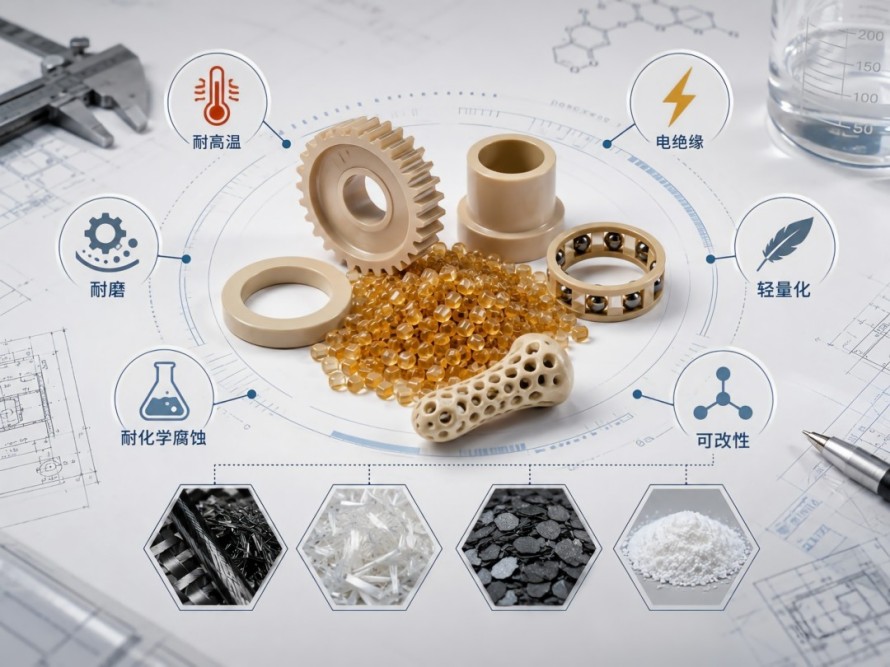
However, PEEK is not a "universal plastic." For certain commercial grades, recommended melt processing temperatures can reach 380–400°C—figures that vary depending on material viscosity, reinforcement systems, and molding processes—thereby imposing stringent requirements on equipment heat resistance, mold temperatures, crystallization control, and annealing procedures. Consequently, it is not a commodity plastic but rather a strategic functional material used in small quantities that is critical to ensuring reliability.
II. The industry is still growing, but capacity expansion does not equate to effective supply.
The global high-end PEEK market is currently dominated by companies such as Victrex, Syensqo, and Evonik. Victrex’s sales volume grew by 12% year-on-year in the 2025 fiscal year, demonstrating resilient demand across the aerospace, energy, and industrial sectors; however, the company also recorded a non-cash impairment charge of £60.6 million against fixed assets at its Panjin, China production site for the first half of 2026. This highlights the challenges involved in translating the design capacity of new PEEK facilities into viable, cost-effective, and market-ready production. Taken together, these figures reveal the true nature of the PEEK industry: the mere construction of a facility does not equate to the establishment of stable, compliant, and economically viable production capacity; large-scale polymerization, downstream purification, batch consistency, and market absorption remain critical factors.
Therefore, when evaluating a PEEK company, one should not focus solely on planned production capacity; instead, greater attention should be paid to qualified output, the proportion of high-end grades, repeat customers, certification progress, and application engineering capabilities.
III. Three key threads of emerging applications, with varying levels of maturity.
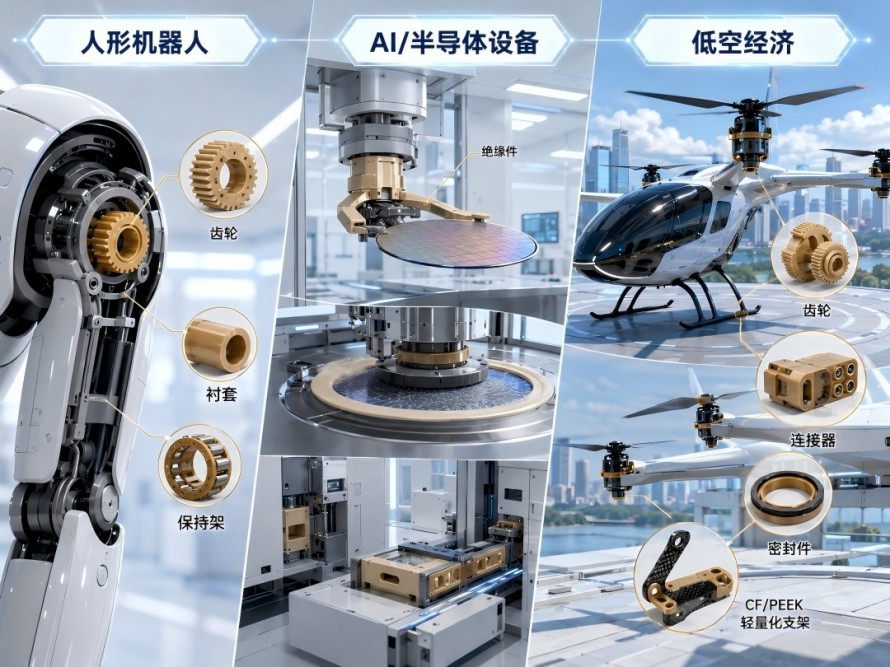
1. Humanoid Robots: Entering via Joint and Transmission Systems
Robot joints require components characterized by low inertia, fatigue resistance, low noise, and wear resistance. PEEK—including its reinforced and wear-resistant grades—is suitable for applications such as planetary gears, bushings, bearing cages, wear rings, insulation components, sensor brackets, and end-effectors. Victrex has already implemented PEEK and thermoplastic composite gears in robotic and automation drive systems, while domestic companies are also advancing the use of PEEK in robot joints, actuators, and structural components.
Policy initiatives are also accelerating validation at the application level. The Ministry of Industry and Information Technology (MIIT) has set a goal to drive the scaled development of humanoid robots by 2027; furthermore, in 2026, the MIIT and the State-owned Assets Supervision and Administration Commission (SASAC) jointly launched a special initiative focused on real-world training for humanoid robots and embodied AI, prioritizing performance improvements for the robot body and key components.
However, "suitability for application" does not equate to "mass adoption per unit." In the short term, PEEK is more likely to be adopted first in joint areas where high rotational speeds, high wear, strict insulation requirements, or significant weight-reduction benefits exist, rather than replacing all aluminum alloy and steel parts. The incremental demand generated by robotics will ultimately depend on total unit shipments, the quantity of material used per robot, material utilization rates, and cost competition against alternative materials such as POM, PA, and PPS.
2. AI: Generating indirect incremental demand via semiconductor manufacturing equipment
PEEK is not a core functional material within GPUs, HBM, or advanced packaging. The impact of AI computing power on PEEK is primarily indirect: the demand for computing power drives the expansion of wafer fabrication, advanced packaging, and testing equipment, thereby increasing the need for components characterized by high purity, low outgassing, low particle generation, and chemical corrosion resistance.
Currently, PEEK is utilized in CMP retaining rings, as well as in wear-resistant components, structural parts, and precision functional components for FOUPs, wafer carriers, and photomask containers; parts for wet cleaning and etching equipment; test sockets; and insulating fasteners. Victrex has reported that its PEEK CMP retaining rings can achieve a service life twice as long as—or longer than—that of PPS materials under comparable operating conditions, thereby reducing the frequency of replacements and equipment downtime.
While this market may not represent the largest volume in terms of consumption, it is characterized by long certification cycles, high added value, and strong customer loyalty. For domestic enterprises, the true challenge lies not in achieving standard mechanical properties, but in mastering parameters such as metal ion content, volatile emissions, wear particle generation, dimensional stability, and long-term batch-to-batch consistency.
3. Low-altitude economy: Functional components lead the way, followed by the adoption of load-bearing composites.
Both drones and eVTOLs require lightweighting, flame retardancy, fatigue resistance, electrical insulation, and manufacturing efficiency. PEEK is suitable for applications such as gears, bearings, bushings, seals, connectors, motor insulation, pumps, valves, and sensor brackets; meanwhile, continuous carbon fiber-reinforced PEEK shows promise for use in brackets, fixtures, and localized load-bearing structures.
Syensqo has incorporated KetaSpire PEEK and related film materials into insulation solutions for drone motors, while Toray Advanced Composites’ Cetex TC1200 represents the category of PEEK-based continuous-fiber thermoplastic composites.
It is worth noting that although PEEK, PEKK, and low-melting-point PAEK all belong to the polyaryletherketone (PAEK) family, they differ in molecular structure, melting point, and processing window. In the realm of thermoplastic composites for aerospace, low-melting-point PAEK—thanks to its wider processing window—may both compete with and complement traditional PEEK.
Regarding the adoption of materials for low-altitude equipment, the sequence is expected to prioritize non-load-bearing functional components as well as electrical and drivetrain parts, followed by load-bearing composites; the latter require additional steps such as structural design, airworthiness certification, and cost assessment.
IV. Mature markets remain the bedrock of the PEEK industry
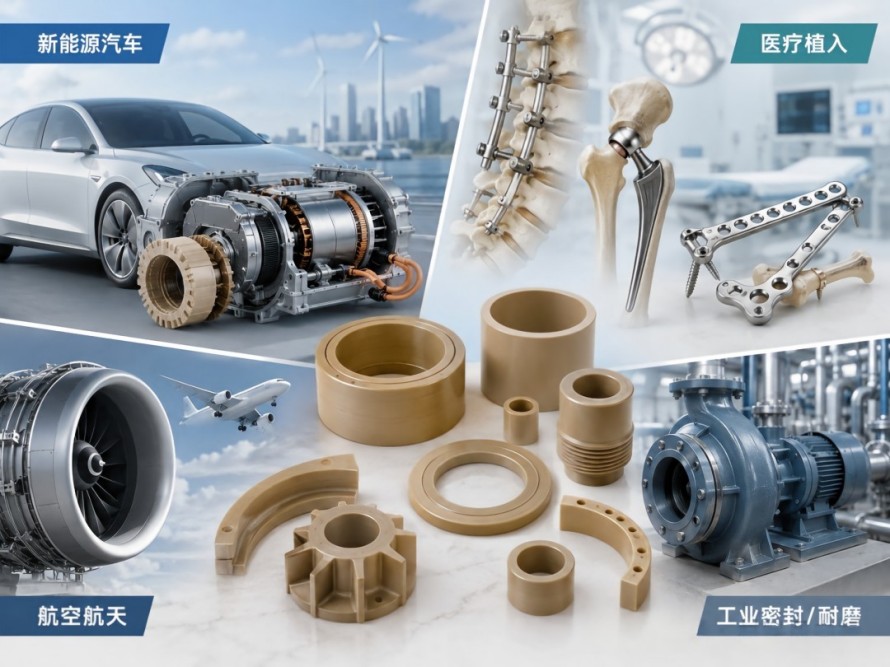
New energy vehicles are enhancing the value proposition of PEEK. Technologies such as 800V platforms, SiC power devices, and high-speed motors increase insulation stress caused by factors like partial discharge, thermal aging, and oil-cooling environments. Both Victrex and Syensqo have launched PEEK-based solutions for magnet wire coatings, slot insulation, and bearing insulation; notably, Syensqo’s PEEK materials for magnet wire and slot insulation have been selected for high-voltage motor projects.
The medical sector presents another area with high barriers to entry. Implant-grade PEEK—characterized by radiolucency, tunable mechanical properties, and excellent biocompatibility—is suitable for applications in spinal, trauma, craniomaxillofacial, and dental devices. Evonik has established a portfolio of materials for long-term implants, dentistry, and medical 3D printing; notably, its implant-grade PEEK filaments are already being used in commercially available 3D-printed spinal implants.
Furthermore, sectors such as aerospace, oil and gas equipment, compressors, sealing components, and industrial wear parts continue to generate relatively stable demand, serving as a crucial foundation for PEEK companies to sustain R&D investment and expand into emerging markets.
V. Key enterprises should not be ranked solely by resin production capacity
Major international players in the PEEK resin and solutions sector include Victrex, Syensqo, and Evonik; notably, Victrex’s subsidiary, Invibio, focuses on medical implant materials. Toray Advanced Composites is a key player in PEEK-based continuous fiber composites, while companies such as Ensinger, Mitsubishi Chemical Advanced Materials, Röchling, Drake Plastics, and Zeus are prominent in the fields of profiles, precision machining, and tubing.
Therefore, when analyzing PEEK-related enterprises, it is essential to distinguish between three distinct capabilities: the ability to produce PEEK resin, the ability to consistently manufacture high-end specialized grades, and the ability to assist customers with part design and certification. These capabilities cannot be equated with one another.
VI. The Next Five Years: Opportunities Lie in Specialization, Not Merely Capacity Expansion
Based on the industry's development stage, the PEEK sector is poised to exhibit three trends: the localization of general-purpose resins will accelerate, driving down prices; specialized materials for semiconductors, medical applications, aerospace, and high-voltage insulation will continue to face high barriers to entry; and resin manufacturers will increasingly expand into composite materials, profiles, and precision components.
In terms of application maturity, semiconductor equipment, high-voltage motors, medical devices, and industrial wear-resistant parts offer relatively high certainty; thermoplastic composites for low-altitude aviation and additive manufacturing represent medium-term growth areas; and humanoid robotics offers significant upside potential, though the volume of material used per unit and the pace of mass adoption remain to be validated.
For material companies, true competitiveness will shift from the basic ability to synthesize PEEK to the capacity to integrate resin grading, composite modification, molding and processing, component design, testing and evaluation, and customer certification.
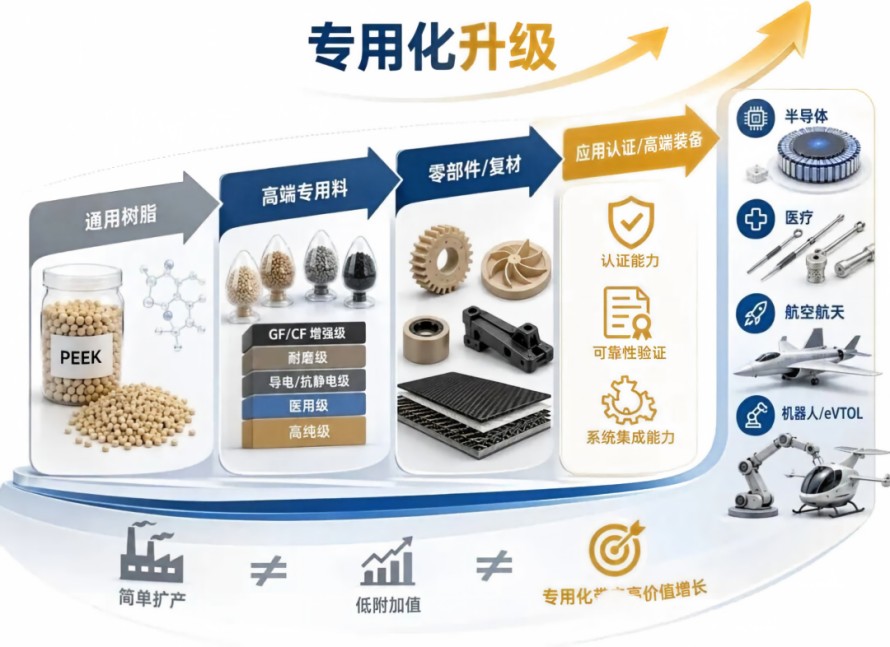
Downstream enterprises should not adopt PEEK blindly; instead, they should evaluate the total lifecycle cost. Material substitution offers sustainable commercial value only when the benefits derived from weight reduction, extended service life, reduced maintenance, insulation, or integrated molding outweigh the material's price premium.
Conclusion
New opportunities for PEEK have not arisen simply because the robotics, AI, and low-altitude economy sectors have labeled it a "hot" material; rather, they stem from the fact that requirements for materials in high-end equipment are shifting from a focus on single-property strength to a need for the synergy of multiple performance characteristics.