

Many automation and semiconductor equipment engineers struggle to decide between PEEK and PTFE bearings when selecting sliding bearings, wondering which offers better wear resistance. Both types of engineering plastic bearings are self-lubricating, but their wear resistance varies significantly depending on load, temperature, and operating duration. Choosing the wrong material can lead to frequent part replacements and equipment downtime, driving up long-term production costs.
Many procurement professionals focus solely on the initial coefficient of friction during selection, overlooking how wear changes under continuous operation. PTFE has a relatively low coefficient of friction but is a softer material, making it prone to creep under high loads during long-term operation; PEEK bearings offer greater rigidity, and when combined with modified formulations, they deliver more stable wear resistance in continuous drive applications. To control spare part wear, a comprehensive comparison based on specific equipment operating conditions is necessary.
I. What is PEEK bearings
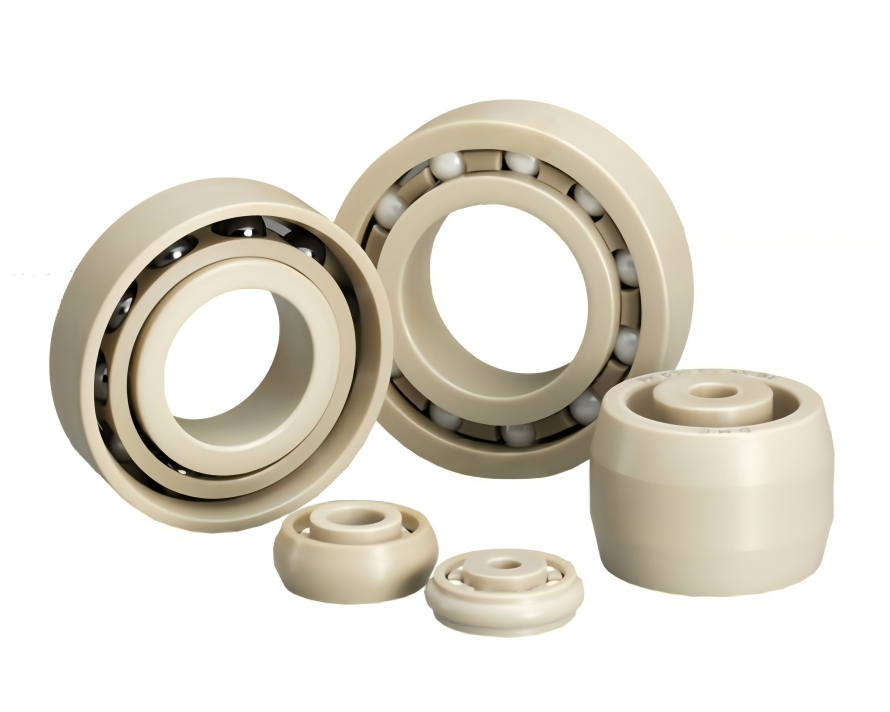
PEEK bearings are specialty engineering plastic bearings made from polyetheretherketone (PEEK) as the matrix material (often reinforced with carbon fiber or glass fiber). They feature core properties such as high-temperature resistance (up to 260°C for extended periods) and chemical resistance, making them suitable for replacing metal in extreme operating conditions.
1. Core Properties
Temperature Resistance and Strength: Long-term operating temperature up to 260°C, with short-term resistance up to 300°C; after modification, tensile strength can reach 185 MPa, maintaining high mechanical strength even at high temperatures.
Self-lubricating and Maintenance-Free: With a coefficient of friction as low as 0.1–0.3, these bearings can operate for extended periods without external lubrication, significantly reducing maintenance frequency.
Lightweight and Corrosion-Resistant: Density of approximately 1.51 g/cm³ (only 40% that of stainless steel); resistant to corrosion by strong acids, strong alkalis, and organic solvents; resistant to aging and radiation.
Dimensional Stability: Low coefficient of thermal expansion and strong creep resistance; tolerances can be controlled within 0.1% under precision operating conditions.
2. Main Structures and Types
Sliding Bearings: The most common form, utilizing PEEK’s low-friction properties as a bearing shell or friction-reducing layer; suitable for high-speed, heavy-duty gearboxes, deep-well pumps, and similar applications.
Rolling Bearings: The inner and outer rings or retainers are made of PEEK, while the rolling elements are often paired with zirconia ceramic balls, combining the advantages of electrical insulation and lightweight construction.
Composite Structures: Often modified by adding carbon fiber, graphite, or PTFE to compensate for the lack of rigidity in pure PEEK and to enhance wear resistance.
3. Typical Applications
High-End Equipment: Robot joints, reducers, high-speed gearboxes (as a replacement for Babbitt alloy).
Harsh Environments: Chemical pumps, magnetic drive pumps (corrosion-resistant), semiconductor manufacturing equipment (high-purity, static-free).
Energy and Transportation: Wind turbine main shafts, aircraft engine components, automotive braking systems, and new energy vehicle components
II. What Is PTFE Bearings
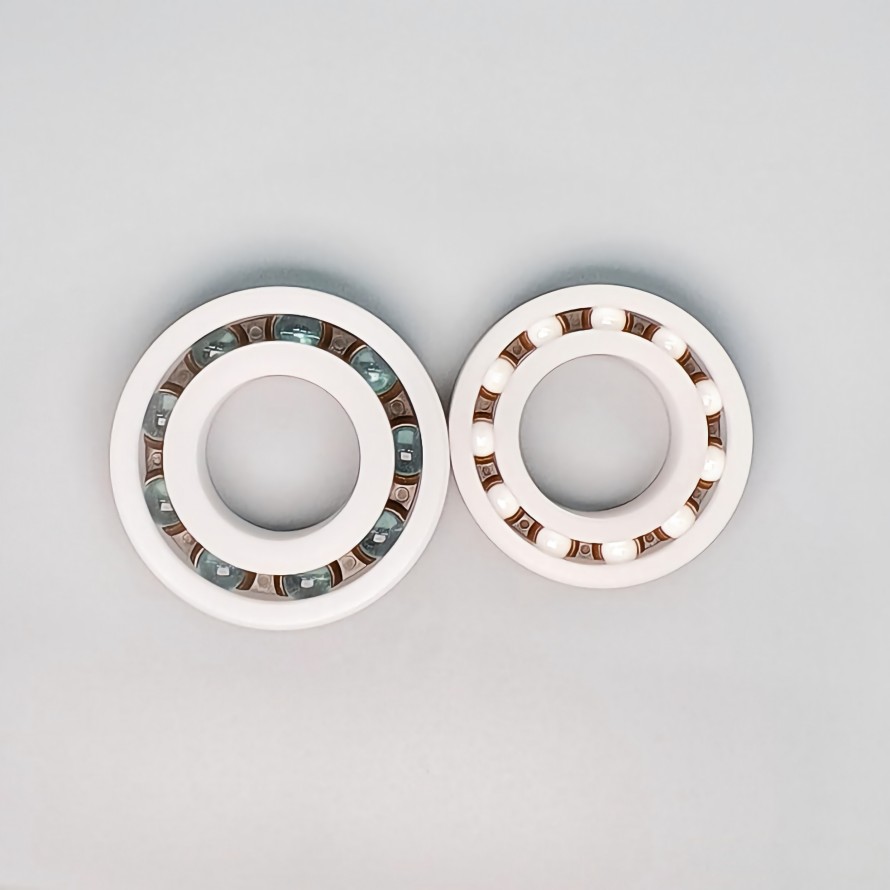
PTFE bearings are sliding bearings manufactured with polytetrafluoroethylene (PTFE) as the core self-lubricating material, enabling low-friction, maintenance-free operation without the need for external lubrication.
1. Core Definition and Structure
Essence: These are oil-free, self-lubricating sliding bearings that utilize PTFE’s extremely low coefficient of friction to form a transfer film on the friction surfaces, thereby reducing friction.
Typical Structure: Most feature a composite-layer design, typically consisting of a steel backing (providing strength), a porous sintered bronze layer (for heat transfer and structural bonding), and a PTFE working layer (the friction surface); structures made of pure PTFE or PTFE fabric liners are also available.
Principle of Operation: During motion, a trace amount of PTFE is transferred to the mating shaft surface to form a lubricating film, enabling “dry” or “low-oil” operation.
2. Key Characteristics
Maintenance-Free: No need for periodic lubricant (oil or grease) replenishment; suitable for sealed or hard-to-access applications.
Low Friction: The coefficient of dynamic friction typically ranges from0.04 to 0.20, resulting in low startup and operating resistance.
Wide Temperature Range: Suitable for temperatures ranging from approximately-200°C to +250°C (some modified materials can withstand up to 280°C).
Corrosion Resistance: PTFE offers excellent chemical stability and resists corrosion from acids, alkalis, and most solvents.
Limitations: Load-carrying capacity is lower than that of rolling bearings; thermal conductivity is poor; and the material is sensitive to dust and particulates (which can easily cause abrasive wear).
3. Major Applications
Automotive Industry: Suspension systems, steering links, and transmission linkages.
Construction Machinery: Excavator joints and crane pins.
Aerospace and High-End Equipment: Flight control mechanisms, robot joints (PTFE fabric-lined types are commonly used to ensure high reliability).
Food and Pharmaceutical Industries: Cleaning equipment and conveyor lines requiring oil-free environments.
In short, PTFE bearings are mechanical “joints” that solve lubrication challenges through the material’s inherent properties; their core value lies in simplifying lubrication systems and reducing total lifecycle costs
III.A Comparative Test of the Core Performance of Two Types of Bearings
| Performance Characteristics | PTFE Bearings | PEEK Bearings |
| Continuous Operating Temperature Range | -200°C to 260°C | -50°C to 250°C |
| Load Capacity | Prone to deformation under low and high loads | Medium to high loads; superior creep resistance |
| Wear Behavior During Continuous Operation | Performs well under low speeds and light loads; prone to wear under heavy loads | Lower wear rate during long-term continuous operation |
| Dimensional Stability | Prone to deformation when exposed to heat and pressure | Minimal dimensional changes under temperature fluctuations |
| Suitable Lubrication Conditions | Oil-free, self-lubricating bearings are preferred | Can operate under dry friction and is also suitable for grease lubrication |
As the table clearly shows, there is no single material that is universally superior; the key is matching the operating conditions. In light-load, intermittent-operation environments, PTFE bearings are sufficient; for precision equipment involving prolonged continuous operation and relatively heavy loads, PEEK bearings are a better fit.
IV. How to Choose Based on Different Scenarios
1. Light-Load Intermittent Operations: PTFE Bearings Are Recommended—Low temperatures, light loads, intermittent equipment start-up and shutdown, short daily operating hours, and no sustained compressive stress.
The self-lubricating properties of PTFE bearings can be fully utilized, and their relatively low procurement cost makes them suitable for simple fixtures and short-term debugging equipment.
2. For precision equipment in continuous operation, prioritize PEEK bearings. These are suitable for semiconductor drive modules and automated assembly line fixtures where equipment operates intermittently around the clock and requires strict clearance control.
PEEK bearings offer outstanding creep resistance; they are less prone to increased clearance or abnormal noise during long-term use, thereby reducing downtime costs associated with frequent shutdowns for spare part replacement. This is also a common solution adopted by most precision equipment manufacturers in Guangdong.
A semiconductor equipment manufacturer encountered this exact issue: the transmission components were originally fitted with PTFE bearings, which showed significant wear and produced abnormal noises after 20 days of continuous operation, necessitating a shutdown for replacement. After switching to modified PEEK bearings, the wear rate improved under identical load and temperature conditions, and the equipment’s maintenance cycle was significantly extended.
V. Common Pitfalls in Selection
Do not rely solely on the coefficient of friction to assess wear resistance. Some engineers mistakenly believe that a lower coefficient of friction indicates greater wear resistance; however, during continuous operation under pressure, material creep and hardness both affect service life.
PTFE is prone to plastic deformation under compression; even if initial friction is smooth, the clearance will continue to widen during long-term operation. Temperature fluctuations must also be taken into account. While the temperature resistance ranges of the two materials are similar, PEEK bearings exhibit less dimensional variation under repeated temperature fluctuations, making them suitable for use inside sealed, precision chambers.
FAQ
Q: In a dry-friction environment without lubrication, which should I choose: PEEK bearings or PTFE bearings?
A: For short-term, intermittent operation, PTFE bearings can be used; for long-term, continuous dry-friction operation, PEEK bearings are recommended, as they offer better wear control.
Q: Can PEEK bearings be used as direct replacements for existing PTFE bearings?
A: Yes, they can be used as replacements, but it is necessary to verify the fit tolerances and operating load parameters. We provide test samples and can adjust the machining process as needed.