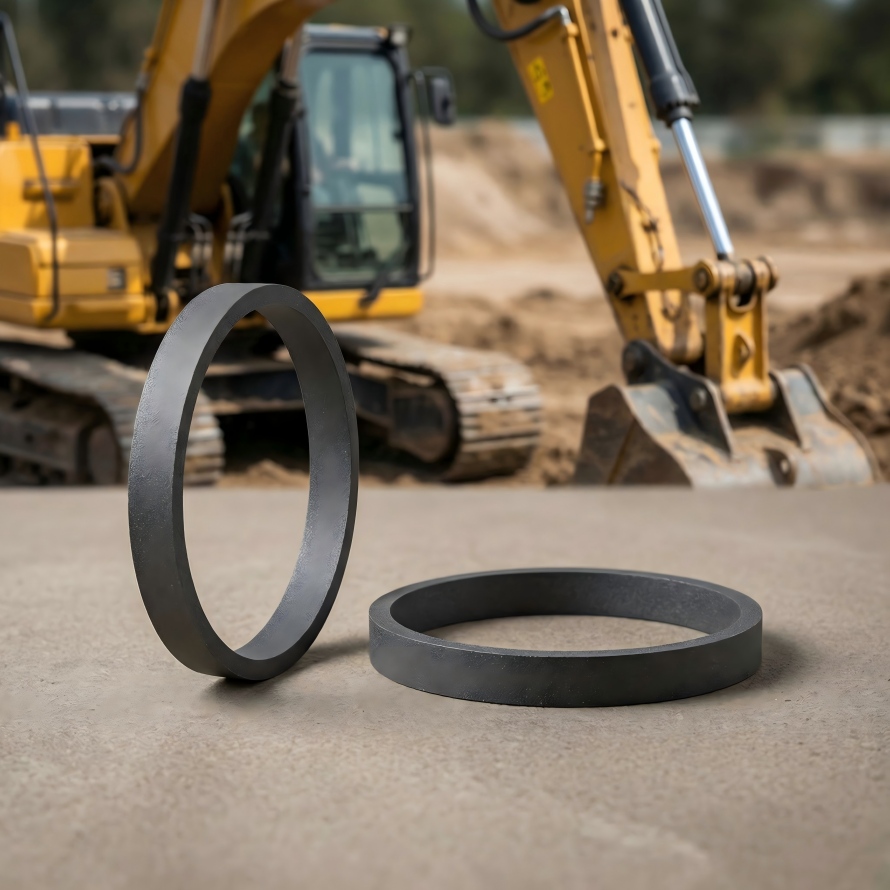
Analysis of commonly used 40 wt% bronze-filled PTFE molded, sintered rods, sheets, tubes, and machined parts.
1. The key finding is that the “oxidation risk” of bronze-filled PTFE primarily stems from the exposed surfaces of the bronze filler, not from the PTFE matrix. PTFE itself is highly chemically inert and has very low moisture absorption; bronze filler, however, is subject to surface oxidation/corrosion in the presence of oxygen, water films, chloride ions, acids, alkalis, or sulfur-containing atmospheres. Supplier documentation also explicitly states that bronze oxidation may cause discoloration of the finished product, but minor surface oxidation does not necessarily affect product quality. At the same time, bronze-filled PTFE exhibits reduced chemical resistance compared to pure PTFE in certain acids and alkalis.
The actual risk ranking is typically as follows:
unsintered or premixed powder > freshly machined surfaces > sintered rods/sheets/tubes > hermetically sealed finished parts.
The reason is straightforward: powders and freshly machined surfaces have a large surface area, resulting in greater exposure of the bronze; in sintered materials, most of the bronze is fully or partially encapsulated by PTFE, with only the surface layer of filler coming into contact with the environment.

2. Oxidation Mechanism and Risk Thresholds: Bronze-filled PTFE is typically used to enhance strength, stiffness, thermal conductivity, wear resistance, and cold-flow resistance. A typical 40% bronze + 60% PTFE material has an upper limit for continuous use of approximately 260 °C and is commonly used in applications such as bearings, bushings, seals, piston rings, and wear rings. However, bronze is essentially a copper-based alloy; when exposed to air, it forms copper oxides, which initially appear as brown, dark brown, or black discoloration. Under conditions involving corrosive substances such as SO₂, NO₂, O₃, and Cl⁻, as well as wet-dry cycling, these can further develop into copper rust or copper salt corrosion products, potentially turning the color green or blue-green.
Mild, uniform brownish-black surface discoloration is generally considered a cosmetic risk; and does not necessarily lead to actual failure in ordinary wear-resistant parts, guide rings, or support rings. Supplier documentation also notes that bronze oxidation can cause discoloration of finished products without affecting product quality. However, the following situations should be considered functional risks and should not be simply approved as “cosmetic oxidation”: the appearance of green or blue-green powder on the surface that can be wiped off with a white cloth, leaving black or green residue; increased roughness on sealing lips or sliding surfaces; pitting, pinholes, or powdering; or when parts are used in high-cleanliness, semiconductor, food-contact, oxygen systems, medical, or precision valve seat applications—scenarios sensitive to precipitates and particulates.
High-risk media primarily include water vapor condensation, salt spray, chloride ions, acids, strong alkalis, ammonia/amines, sulfur-containing atmospheres, damp cardboard boxes/ wood volatiles, inadequately cleaned water-based cutting fluids, and hand perspiration. In particular, the combination of chloride ions and moisture requires special attention: in the corrosion of copper alloys, oxygen, moisture, and chlorides can form a cyclic corrosion mechanism; experiments on copper/chloride systems at 70% RH reported in the literature have also observed corrosion products such as basic copper chloride.

3. Temperature and the Risk of Thermal Oxidation/Thermal Degradation: Under normal storage conditions, the PTFE matrix is generally not the primary cause of oxidative failure; the real concerns are high-temperature processing and localized overheating. Although fluoropolymers have high thermal stability, they decompose slowly at high temperatures, and safety handling guidelines indicate that metal powders—particularly bronze—can reduce the thermal stability of fluoropolymers; The same guidelines specify a typical maximum continuous operating temperature of 260 °C for PTFE, with typical processing temperatures of approximately 380 °C.
Therefore, operations near sintering, baking, hot pressing, or welding of bronze-filled PTFE, as well as maintenance work near flames or electric arcs, must not be handled solely on the basis that “PTFE is highly heat-resistant.” High-temperature ovens, sintering furnaces, and hot-working equipment must be equipped with forced exhaust ventilation; safety handling guidelines require ventilation for operations such as hot working, drying, extrusion, and sintering that may release fumes. Where necessary, cold-working processes such as high-speed grinding, mixing, and machining must also be ventilated to remove dust and particles.
4. Moisture Control: The key is not “PTFE absorbing moisture,” but rather “preventing condensation and entrapped moisture.” PTFE resin itself is not a typically hygroscopic plastic; problems usually stem from condensation after opening cold packages, water trapped in the powder gaps, residual cleaning solutions, cutting fluid residues, or moisture inside the packaging. Handling guidelines for PTFE pellet resin explicitly state that PTFE does not absorb moisture; however, cold powder exposed to humid air can become damp due to condensation, and this moisture can cause preforms to crack during sintering. The same guidelines recommend storing and preforming uncooled resin in a clean, dry area at 23–27 °C and below 50% RH.
Powder or Premixes
Before opening a container of powder, ensure that the powder temperature is above the ambient dew point. If drums, bags, or powder are transferred from a cold warehouse, refrigerated truck, or air-conditioned room to a warmer, more humid environment, do not open them immediately; allow the sealed packaging to return to room temperature fully. The recommended practice for storing granular PTFE is to let cold material sit sealed at 23–27 °C for 24–48 hours before opening. Supplier documentation for fine-powder PTFE also emphasizes the importance of controlling the ambient dew point prior to preforming to prevent condensation on the resin surface, and of maintaining clean storage and handling facilities.
Bronze-filled PTFE powder that has become noticeably damp should not be directly pressed or sintered. The correct procedure is to first isolate the batch and inspect it for clumping, abnormal color, green or blue-green powder, a metallic odor, or the smell of cutting fluid or cleaning agents. If only slight condensation is present, surface moisture may be slowly removed under low-temperature, dry air, or vacuum conditions following internal validation, and the flowability, bulk density, color, sieve residue, and appearance after test sintering should be re-tested. If green corrosion products or black powder that can be wiped off are present, it is recommended to scrap the material or downgrade it; it is not recommended for use as raw material for precision seals or wear-resistant parts.
High-temperature drying is not recommended as a routine practice. Due to the significant density difference between PTFE and bronze in bronze-filled powders, agitation, vibration, and hot-air blowing may cause filler segregation; high-temperature air may also accelerate oxidation of the exposed bronze surface. In the absence of supplier specifications, low-temperature drying may be used as a “remediation verification for non-conforming batches” rather than a standard process step.
Bars, Sheets, Tubes, and Machined Parts
Sintered bronze-filled PTFE finished products generally do not require moisture-removal drying as is required for PA, PET, or PBT. If parts have undergone water washing, ultrasonic cleaning, wet machining, or prolonged exposure to a high-humidity environment, the priority is to completely remove surface water, pore water, and residual cleaning solutions. For precision parts, it is recommended to blow-dry them with clean, dry compressed air before performing low-temperature drying; after drying, they should be cooled to room temperature before being sealed in packaging to prevent re-condensation when hot parts are placed in cold bags or cold parts are exposed to humid air.

5. Storage Guidelines: The primary objective of storage is to prevent the bronze filler from coming into contact with a continuous water film, salts, and corrosive gases. It is recommended to maintain a stable storage temperature within the normal temperature range to avoid condensation inside and outside the packaging caused by diurnal temperature fluctuations. Relative humidity should be kept below 50% RH; in coastal areas, during the rainy season, or for long-term storage, it is recommended to lower this further and use desiccants and humidity indicator cards. PTFE resin handling guidelines emphasize cleanliness, dryness, and prompt sealing of packaging. After opening a drum to retrieve material, the inner bag should be immediately resealed and the drum lid securely closed to prevent contamination and moisture ingress.
Powdered materials should preferably be stored in their original packaging, with the inner bag tightly sealed and the outer drum sealed. Retrieve only the amount needed for the current shift each time, using clean, dry tools; do not casually pour leftover material, spilled material, or sieve residue back into the original drum. For high-value or long-term inventory, aluminum-plastic composite barrier bags, desiccants, and humidity indicator cards may be used, with nitrogen purging if necessary; however, all packaging and rust-preventive materials must first undergo compatibility testing to prevent contamination of PTFE surfaces by volatile amines, sulfides, or oily rust inhibitors.
Finished rods, sheets, and machined parts should be bagged individually or packed in separate layers to avoid exposed stacking. Sliding surfaces, sealing surfaces, and thin-walled components must be protected from direct contact with cardboard boxes, wooden pallets, sulfur-containing rubber, PVC flexible films, chlorine-containing cleaning agents, and acidic or alkaline chemicals. If water-based coolants are used during machining, the parts should be rinsed as soon as possible and thoroughly dried; salts in hand perspiration can also accelerate corrosion of copper-based fillers, so it is recommended to wear clean gloves when handling precision parts.
6. Acceptance and Rejection Criteria
Acceptable conditions typically include: a uniform brown, bronze, or slightly darker color; a surface free of powder, pitting, or unusual odors; no noticeable green or black transfer when wiped with a white cloth; and dimensions, density, hardness, surface roughness, and friction surface appearance that comply with the drawings or inspection specifications.
Conditions requiring isolation or rejection include: a failed humidity indicator card or the presence of water droplets inside the packaging; powdered material that has hardened into lumps accompanied by discoloration; green or blue-green spots on the part surface; black powder that can be wiped off the sliding surfaces; corrosion pits near holes, grooves, or sealing lips; or the presence of bubbles, cracks, black spots, delamination, or abnormal odors after sintering. PTFE processing guidelines place particular emphasis on cleanliness, as PTFE is prone to static electricity and the adsorption of particulate contaminants; high-temperature sintering can transform even minute contaminants into visible defects.
7. The Three Most Critical Points
First, do not open a cold container. As long as the powder temperature is below the ambient dew point, condensation will form upon opening; just because PTFE does not absorb water does not mean the powder will not be contaminated by moisture.
Second, do not mistake green corrosion for ordinary discoloration. Uniform brownish-black discoloration is usually surface oxidation; green/blue-green discoloration, powdering, and pitting typically indicate copper salt corrosion—in particular, suspect chloride ions and moisture.
Third, the chemical resistance of bronze-filled PTFE cannot be equated with that of pure PTFE. While the PTFE matrix is highly inert, the bronze filler reduces the composite material’s resistance to certain acids, alkalis, and corrosive atmospheres; when selecting materials, evaluate them as “composites” rather than “pure PTFE.”