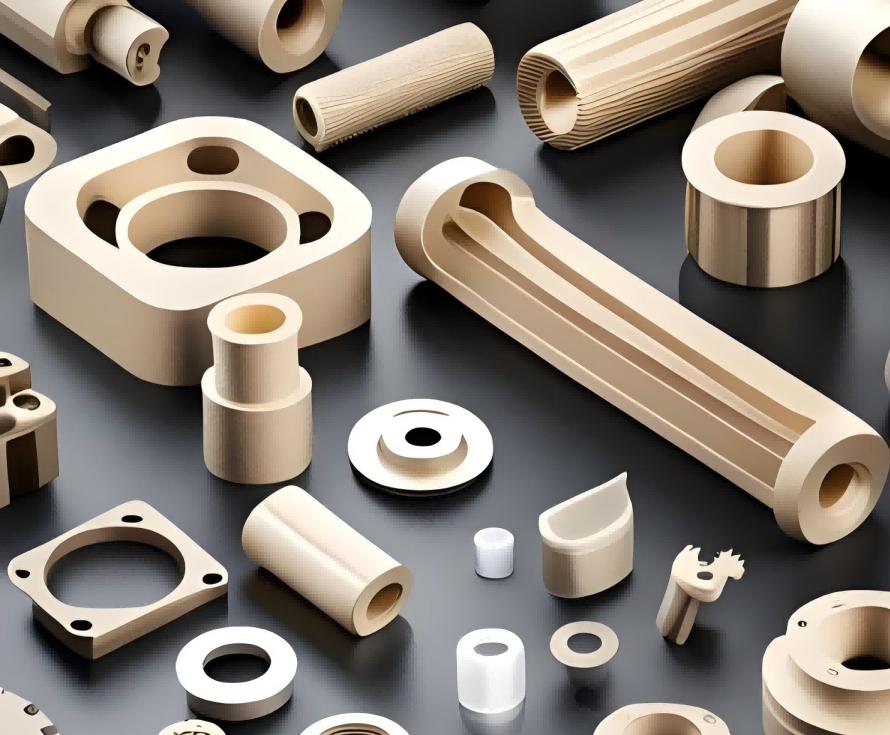
Applications of Commonly Used Plastics In Engineering
I. Based on the characteristics and requirements of the parts, the chemical, physical, and mechanical properties of the plastic itself, and the molding method, a comprehensive analysis is conducted before rational selection. The following are materials selected for parts with different applications.
1. General Structural Parts
(1) Requirements: No special requirements for strength and heat resistance; generally used to replace steel or other materials. However, due to large batch sizes, high productivity and low cost are required. Sometimes, certain requirements are placed on appearance.
(2) Application Examples: Automotive regulator covers and horn rear covers, motor covers, various instrument covers, covers, handwheels, handles, oil pipes, pipe fittings, fasteners, etc.
(3) Materials include low-density polyethylene, polyvinyl chloride, modified polystyrene (203A, 204), ABS, high-impact polystyrene, polypropylene, etc. These materials can only withstand low loads and are used in the range of approximately 60~80℃ when the stress is small.
2. Transparent structural parts
(1) Requirements:No special requirements for strength and heat resistance. Generally used to replace steel or other materials. However, due to large batch sizes, high productivity and low cost are required. Sometimes, certain requirements are placed on appearance, and good transparency is essential.
(2) Application Examples: Transparent housings, various automotive lamp covers, oil level indicators, oil cups, sight glasses, optical lenses, signal lights, explosion-proof lights, protective glass, and transparent pipes, etc.
(3) Materials: Modified acrylic glass (372, 613), acrylic glass, AS resin, modified polystyrene (204, 203A), polystyrene, polycarbonate, thermoplastic polyester
3. Wear-resistant load-bearing transmission parts
(1) Requirements: High strength, rigidity, toughness, wear resistance, fatigue resistance, high heat distortion temperature, and dimensional stability are required.
(2) Examples of applications: Bearings, gears, racks, worm gears, cams, rollers, couplings, etc.
(3) Materials: Nylon, MC nylon, polyoxymethylene, polycarbonate, polyphenolic resin, chlorinated polyether, reinforced polypropylene, polyphenylene sulfide, etc. These plastics have tensile strengths above 60 MPa and operating temperatures of 80~120℃.
4. Friction-reducing and self-lubricating parts
(1) Requirements: Mechanical strength requirements are often not high, but the movement speed is relatively high. Therefore, low friction coefficient, excellent wear resistance, and self-lubricating properties are required.
(2) Examples of applications: Piston rings, mechanical dynamic seals, packings, bearings, etc.
(3) Materials: Polytetrafluoroethylene (PTFE), filled PTFE, PTFE-filled polyoxymethylene (POM), perfluoroethylene propylene (F-46), oil-impregnated POM, ultra-high molecular weight polyethylene, etc.; low-pressure polyethylene can be used under small loads and low speeds.
5. High-Temperature Resistant Structural Parts
(1) Requirements: In addition to the requirements for wear-resistant load-bearing transmission parts and friction-reducing self-lubricating parts, these parts must also possess high heat distortion temperature and high-temperature creep resistance.
(2) Application Examples: Structural transmission parts operating at high temperatures, such as automotive gearbox covers, bearings, gears, piston rings, seals, valves, valve stem nuts, etc.
(3) Materials:Polysulfone, polyphenylene ether sulfone, fluoroplastics (F-4, F-46), polyimide polyphenylene sulfide, polytetrafluoroethylene, graphite-filled polyphenylene ether sulfone and polyarylsulfone, and various glass fiber reinforced plastics, etc. These materials can all be used above 150℃.
6. Corrosion-resistant Equipment and Parts
(1) Requirements: Good corrosion resistance to acids, alkalis, and organic solvents, as well as a certain mechanical strength.
(2) Examples of Applications: Chemical containers, pipes, valves, pumps, impellers, agitators, and their coatings or linings, etc.
(3) Materials: Polytetrafluoroethylene (PTFE), perfluoroethylene propylene (F-46), polychlorotrifluoroethylene (F-3), chlorinated polyether, ABS, polyvinyl chloride, polycarbonate, low-density polyethylene, polypropylene, polystyrene, polyphenylene sulfide, phenolic plastics, etc.
II. Due to the poor thermal conductivity of plastics, careful design is essential to ensure optimal heat dissipation. For example, when using composite plastics with a metal matrix, fillers with good thermal conductivity must be added, or a metal structural design facilitating heat dissipation must be adopted.
III. Like metals, each plastic has a maximum operating speed (v) and load (p) when used as a bearing material, i.e., α = constant. Different plastics have different α values; for example, nylon α = 1.47, and polyoxymethylene α = 1.2. When designing for use, the load and speed range must be determined based on the material used. Furthermore, it is crucial to note that each plastic has its own pressure and speed limits. Exceeding these limits, regardless of the fixed speed or load conditions, even if the product of pv does not exceed the allowable pv value, will prevent its use.
IV. Because plastics are prone to expansion and deformation when heated, sufficient clearance must be considered when designing bearings and other components. This is generally approximately 0.005d (d is the bearing diameter), but the clearance varies depending on the plastic.